



The IBV promotes the use of Extended Reality to improve surgical precision and optimise pre-operative planning
The clinical field is increasingly demanding solutions that help improve surgical precision, optimise pre-operative planning and provide new, risk-free ways of training. In this context, Extended Reality (XR) has become established as a tool with enormous potential to transform surgical practice, given this technology’s ability to display additional digital information in holographic form—such as three-dimensional anatomical models based on analysis of the patient’s medical imaging—and to enable specialists to interact with them. By enabling anatomical structures to be manipulated and offering a level of detail beyond that achievable with two-dimensional images, Extended Reality supports deeper understanding and more accurate pre-operative analysis.
In this context, IBV has launched the XR-SURGICAL project, whose main objective is to generate and validate Extended Reality scenarios to support specialists in surgical planning, with a particular focus on the development and accurate positioning of digital elements for surgical guidance through the use of Mixed Reality (MR).
The project is enabling, based on medical imaging, the development and validation of highly immersive environments tailored to specific clinical cases. According to Carlos Atienza, Director of Innovation for the Health Area at IBV, “work is underway to develop a Mixed Reality environment to support surgical planning for a transfemoral amputation case requiring revision surgery. To this end, medical imaging has been processed in order to obtain the patient’s pathological anatomy, including the femur and structures relevant to the surgery, such as the femoral vasculature and adjacent musculature.
By developing and implementing a tracking methodology specific to this use case, it is possible to deploy holographic elements projected onto what could be the patient’s leg, providing information about their internal structure so as to support the clinician throughout the surgical planning process.”
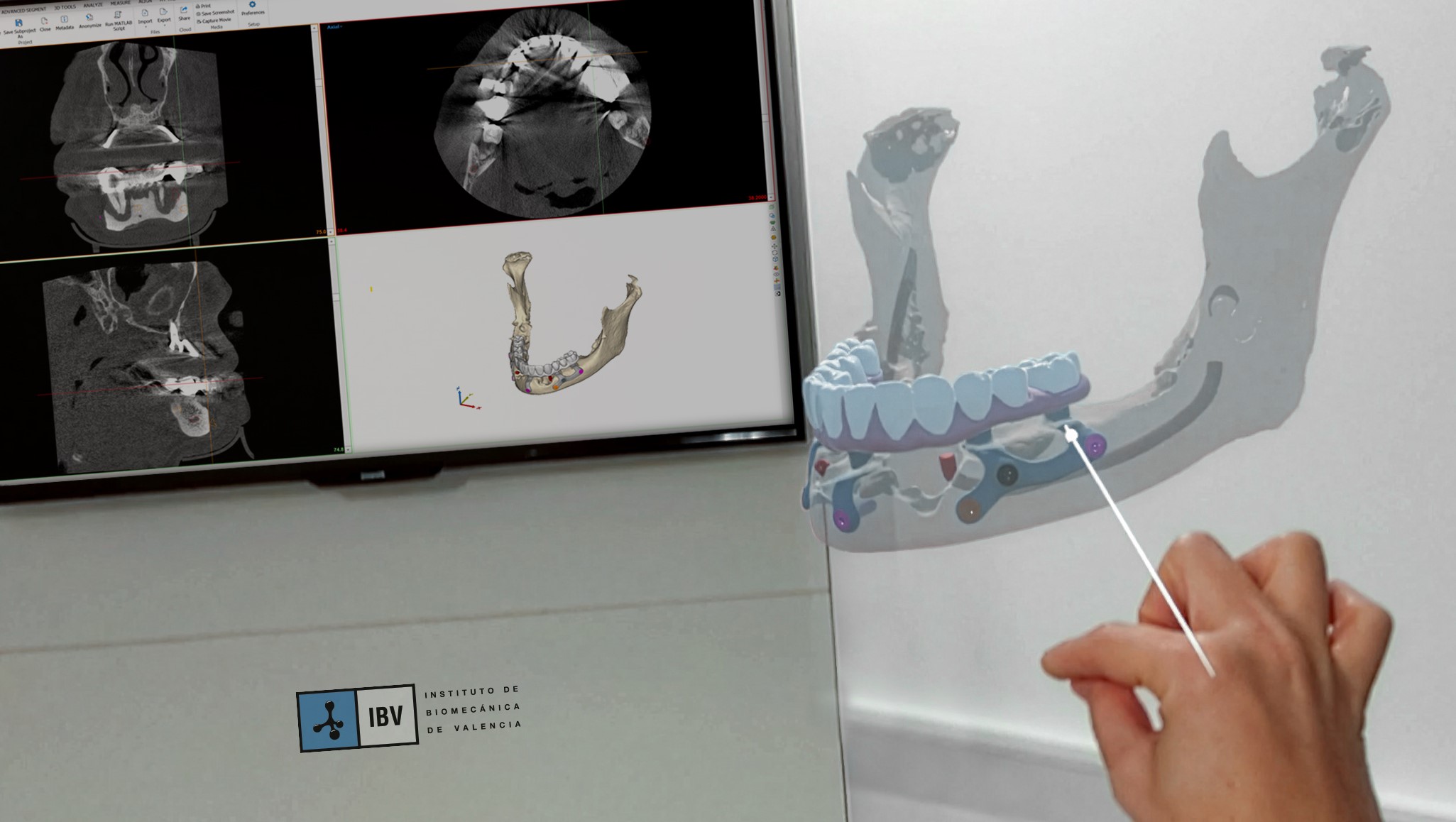
Another example of the potential of the XR-SURGICAL research is in maxillofacial surgery. With Mixed Reality, it is possible to visualise and overlay, in the patient’s real environment, the digital information obtained from medical imaging, including the 3D-reconstructed mandible, the dental nerve pathway, surgical guides for drilling, and the planned position of the implant and the temporary dental prosthesis. The registration and tracking methodology developed by IBV for this specific case ensures correct alignment between the digital models and the real environment. This accurate overlay facilitates a more intuitive three-dimensional understanding of the anatomy and implant planning.
“The health sector demands solutions that go beyond theoretical approaches. With XR-SURGICAL we aim to design and validate Extended Reality scenarios applied to specific clinical cases, generating knowledge that is useful both for clinical professionals and for companies in the healthcare sector,” Atienza added.
Multi-sector collaboration
Within this initiative, IBV is working with leading companies in digital surgery, advanced manufacturing, medical devices and immersive technologies. These include Avamed, specialised in digital surgery; Dyspsela, developer of tailored XR solutions for training and industrial processes; InnoSurgery, focused on advanced manufacturing solutions and technological development for dentistry; Tequir, developer of implantable devices; and IT3D Group, a leader in 3D scanning and digitisation solutions.
“Research such as XR-SURGICAL represents a decisive step towards safer, more effective and more sustainable care models, in line with the digital transformation of healthcare,” Carlos Atienza concluded.
Finally, the XR-SURGICAL project is supported by the Conselleria d’Innovació, Indústria, Comerç i Turisme of the Generalitat Valenciana, through IVACE+i, with funding from the European Union via the Programa FEDER Comunitat Valenciana 2021–2027 (IMDEEA/2025/41).