



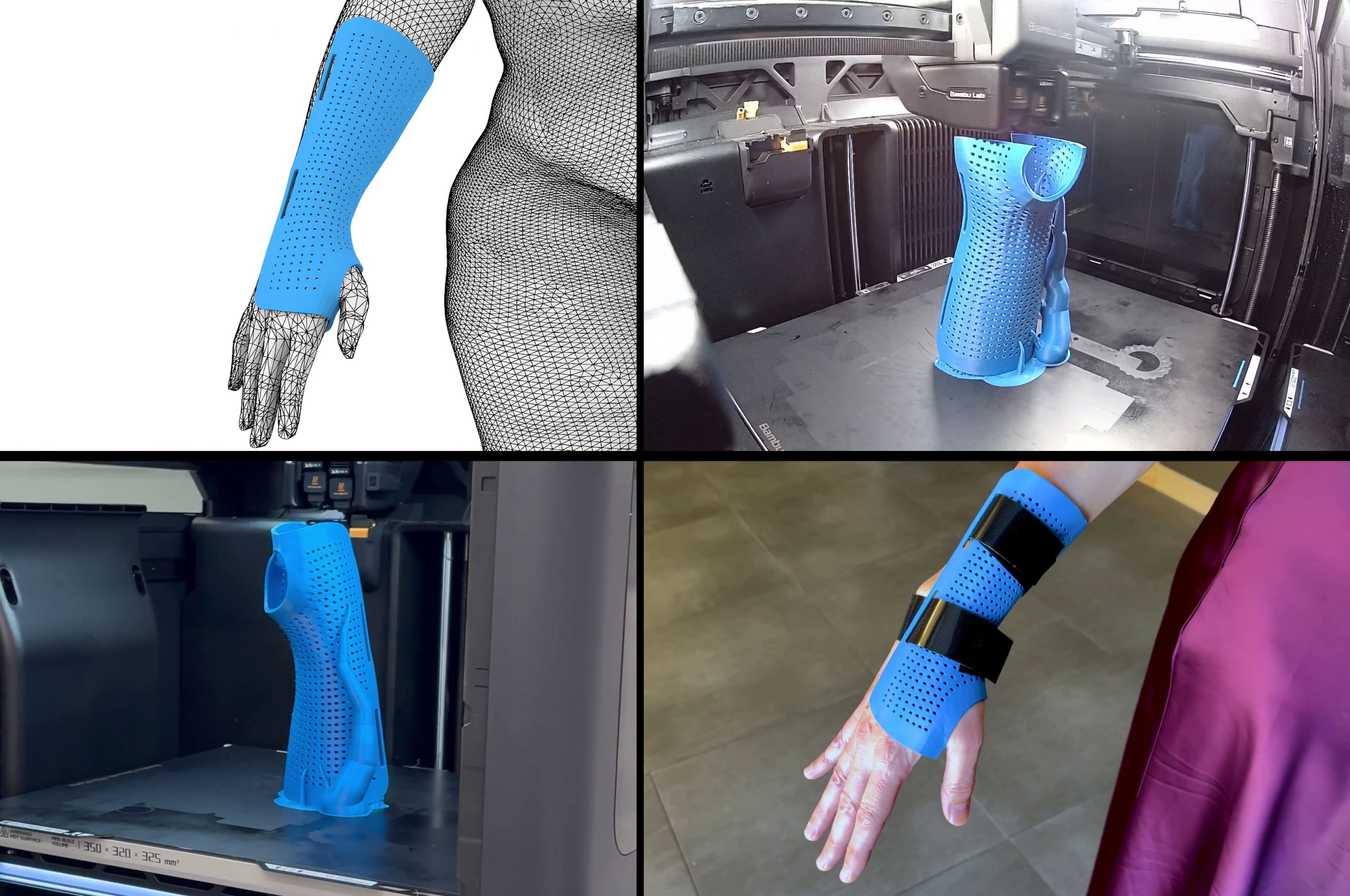
IBV, AIDIMME and AIJU drive the development of personalised and sustainable medical devices through 3D printing
3D printing is profoundly transforming the development of medical devices by enabling the manufacture of prostheses, implants, orthoses, splints, surgical guides and other devices precisely tailored to the anatomical and functional characteristics of each patient. This technology offers significant advantages over conventional methods, including greater design freedom, reduced production times, the possibility of manufacturing complex geometries and improved clinical and functional suitability of products. It also promotes more efficient use of materials, reduces waste, enables on-demand manufacturing and contributes to shorter, local and more sustainable value chains. This model avoids overproduction and helps reduce energy consumption, transport-related emissions and storage requirements.
However, its implementation also presents major challenges for companies in the sector. The incorporation of digital technologies, the adaptation of manufacturing processes, the development of biocompatible materials and the integration of new workflows into hospitals and clinics are among the key challenges.
In this context, the Instituto de Biomecánica (IBV), the Metal-Mechanical, Furniture, Wood, Packaging and Related Industries Technology Institute (AIDIMME) and ‘AIJU manufacturing’, from the Technological Institute for Children’s Products and Leisure (AIJU), have combined their scientific and technological capabilities through ODISEA 3D, a project focused on optimising the design process, materials and manufacturing of “custom-made medical devices” through 3D printing.
The initiative addresses key aspects such as the automation of personalised design, improvements in the functionality and sustainability of the materials used, and the optimisation of additive manufacturing processes.
Among the research activities carried out, IBV has developed new methodologies for optimising the design of medical devices using parametric modelling tools based on previously digitised anatomical shapes. These methodologies make it possible to move towards semi-automated design procedures capable of adapting the morphology of implants, orthoses and other devices to the specific anatomical and functional characteristics of each individual, thereby improving product personalisation and effectiveness in the recovery process. In addition, design verification tools have been incorporated in order to improve the efficiency, safety and functionality of developments.
Meanwhile, the AIDIMME Technology Institute has succeeded in improving the mechanical suitability of titanium — widely used in other implants, but too rigid for the applications addressed by the project — by modifying the 3D printing fusion process to increase elasticity without compromising strength, thus confirming the technical feasibility of personalised implants with mechanical behaviour similar to that of human bone.
AIJU has also developed new biocompatible polymer formulations incorporating polymer blends with ceramic fillers and sustainable additives. These formulations have been applied using additive manufacturing techniques such as material extrusion (MEX) and vat photopolymerisation (VPP), with the aim of improving the repeatability, scalability and functionality of custom-made medical devices, including implantable scaffolds. In addition, the technology centre has worked on optimising additive manufacturing techniques through the optimised design of biomodels and medical devices, both implantable and non-implantable, intended for external use and tailored to each patient, using sustainable manufacturing approaches.
A project with strong involvement from the Valencian business community
ODISEA 3D has benefited from the collaboration of companies from the Valencian Community representing the healthcare, orthopaedic, dental, metallurgical, electromedical and chemical sectors. All of them have contributed industrial expertise and market knowledge, strengthening the practical and transferable nature of the results achieved.
These include Fresdental Innovación y Manufacturas (Fresdental), with more than 20 years of experience specialising in the design and manufacture of customised dental prostheses; Especialidades Médico Ortopédicas (EMO), a benchmark company in the orthopaedics sector with more than 50 years of history; Tequir, focused on the development of medical devices that improve current surgical techniques, particularly within the musculoskeletal system, and interested in technologies that enhance the osseointegration of different implants; Metalográfica de Levante, specialised in thermal and thermochemical treatments for metals used in industrial applications; Pharmadis Electromedical, specialised in the commercialisation of medical devices for both external and implantable use; and Colortec Química, dedicated to the production of tailor-made additives for the polymer industry.
Through this collaboration, IBV, AIDIMME and AIJU have combined scientific and technological capabilities to generate knowledge and technological advances that improve the competitiveness of the Valencian business ecosystem and contribute to a more personalised, sustainable and efficient healthcare system.
Finally, the ODISEA 3D project is supported by the Department of Industry, Tourism, Innovation and Commerce of the Autonomous Government of Valencia, through IVACE+i, with funding from the European Union through the ERDF Programme Comunitat Valenciana 2021–2027 (IMDEEA/2025/40; IMDEEA/2025/9; IMDEEA/2025/15).