



Implementing the OCRA Checklist Method in Ergo/IBV: A tool for the assessment of ergonomic risks associated with repetitive tasks
25 May 2026.
Author/s: Alberto Ferreras Remesal, Sonia Serna Arnau, Carlos Chirivella Moreno, Ángela Gajate Hernández, Alicia Piedrabuena Cuesta.
Instituto de Biomecánica (IBV)
Musculoskeletal disorders resulting from repetitive upper-limb tasks represent one of the main ergonomic risks in the workplace. For their assessment, the OCRA Checklist method has become established as a practical and reliable tool, capable of evaluating factors such as task duration, insufficient recovery periods, movement frequency, applied force, awkward postures and other complementary aspects.
The Ergo/IBV software has incorporated this method, enhancing its application through detailed data collection, automated calculation of indicators, and the ability to analyse both single-task and multi-task workstations with different types of job rotation. The structure of the implemented module guides users through workday organisation, the entry of task-specific data, and the generation of results, which are presented visually and supported by comprehensive reports.
INTRODUCCIÓN
In the field of occupational risk prevention, musculoskeletal disorders arising from repetitive tasks constitute one of the most common and costly workplace health problems. They particularly affect the upper limbs—shoulders, arms, elbows, wrists and hands—where the continuous repetition of movements, combined with force exertion, awkward postures or insufficient recovery periods, can lead to injuries of varying severity. These conditions not only affect workers’ health and wellbeing but also result in sickness absence, reduced productivity and increased costs for organisations.
To address this issue, it is essential to have tools capable of accurately and reliably assessing exposure to these risks. The OCRA Analytical Method (Occupational Repetitive Actions), developed to identify, quantify and classify risk levels associated with repetitive movements, is the international benchmark for assessing the risk of repetitive work involving the upper limbs. However, its application is complex and requires extensive information gathering and detailed calculations.
Within the OCRA family of methods, the OCRA Checklist has gained particular prominence. Derived from the analytical method, it combines a high degree of accuracy with a more streamlined procedure, making it easier to apply in real workplace settings.
Recognising this need, the Instituto de Biomecánica (IBV) has incorporated the OCRA Checklist into the Ergo/IBV software, a platform that integrates advanced ergonomic methodologies and now provides occupational health and safety professionals and ergonomists with a dedicated module for the assessment of repetitive tasks. This integration goes beyond simply digitising the method, introducing substantial improvements in data collection, automatic calculation of indicators and the presentation of results.
DEVELOPMENT
THE OCRA CHECKLIST METHOD: PRINCIPLES AND APPLICATION
The OCRA Checklist is a variation of the OCRA Analytical Method, designed to provide a balance between ease of use and scientific rigour. Its objective is to assess the biomechanical load on the upper limbs during repetitive tasks and determine the extent to which workers are exposed to risk factors.
The methodology is based on the definition of a repetitive task, understood as a task performed in work cycles in which the same movements and technical actions are repeated continuously.
The OCRA Checklist focuses on six major groups of risk factors:
- Duration of repetitive tasks: the total number of hours during which the worker is exposed to repetitive activity throughout the working day.
- Lack of recovery periods: consideration of breaks and rest periods within the work cycle.
- Movement frequency: the number of repetitive technical actions performed during the task.
- Applied force: the level of muscular effort required to perform the task.
- Awkward postures and stereotyped movements: body positions or gestures that increase joint stress.
- Additional factors: other conditions that increase risk, such as exposure to vibration, low temperatures, repeated impacts or high-precision work.
Each of these factors is assigned predefined numerical values. By combining them using specific formulae, the OCRA Checklist Index is obtained.
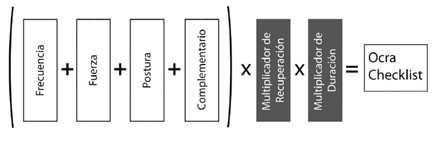
Figure 1. Calculation of the OCRA Checklist Index
The OCRA Checklist Index enables risk to be classified into different levels, ranging from green (acceptable risk) to purple (high risk). This provides a clear and objective view of exposure, facilitating the identification of workstations that require preventive intervention.
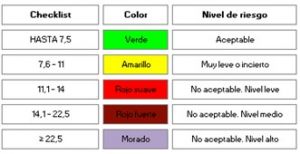
Figure 2. Risk level and colour coding according to the OCRA Checklist Index
INTEGRATION OF THE OCRA CHECKLIST INTO ERGO/IBV
The adaptation of the OCRA Checklist within Ergo/IBV has been based on the revised version of the method (Colombini et al., 2012), implemented in its high-precision mode. This integration represents a significant advance in the practical application of the methodology, transferring the rigour of the analysis into an intuitive and accessible digital environment.
The main features of this implementation include:
- High-precision data collection: the software allows information to be entered in a detailed manner, avoiding the inaccuracies associated with overly general questionnaires. This results in closer alignment between the actual task and the assessment outcome.
- Automated calculation of hours without adequate recovery: one of the most complex aspects of the method is handled through algorithms incorporated into Ergo/IBV, streamlining the process and minimising calculation errors.
- Versatility of application: the module supports both the assessment of a single workstation (single-task) and the analysis of jobs involving task rotation (multi-task), distinguishing between short rotations (equal to or less than one hour) and long rotations (greater than one hour).
This approach enables the software to adapt to a wide variety of workplace situations, ranging from assembly lines with very short work cycles to longer-duration tasks in which employees alternate between different functions throughout their shift.
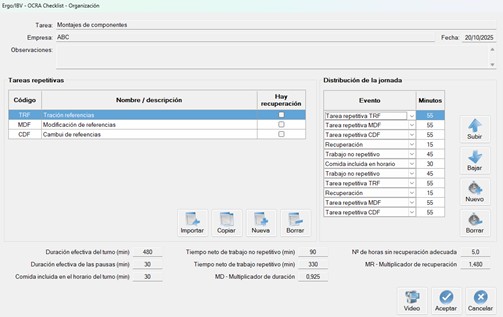
The software organises the assessment process into three main sections, guiding users logically and progressively through the evaluation:
- Organization
This section defines the basic characteristics of the task or tasks being assessed. Information includes:
- Definition of each repetitive task.
- Full workday distribution, including repetitive tasks, non-repetitive work, breaks and meal periods.
Figure 3. Organization data entry screen
2. Data
This section collects the task-specific factors that determine the level of risk:
- Movement frequency.
- Required force level.
- Adopted postures.
- Additional factors.
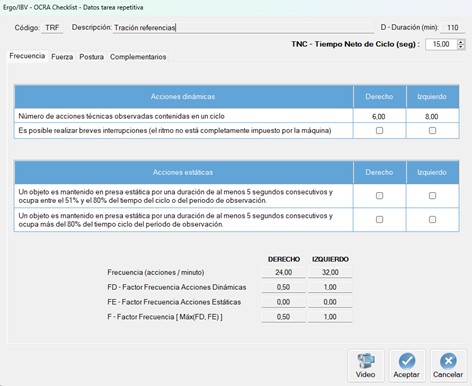
Figure 4. Frecuency data entry screen
results
Once data entry has been completed, Ergo/IBV performs the calculations and presents the results according to the type of analysis:
- Single-task analysis: the formula OCRA Checklist Index = MD × MR × (F + FF + FP + FC) is applied, where each element corresponds to a multiplier or risk factor (duration, recovery, frequency, force, posture and additional factors).
- Multi-task analysis with short rotations: the weighted arithmetic mean of the indices for each task is calculated according to the time spent on each activity.
- Multi-task analysis with long rotations: a more complex three-step procedure is applied:
-
- Calculation of the Real Exposure Index (REI) for each task.
- Ranking of tasks according to their REI, identifying the task with the highest risk.
- Application of a specific formula to combine all values into a single multi-task exposure index.
Results are displayed visually using a colour-coded system that immediately indicates the level of risk.
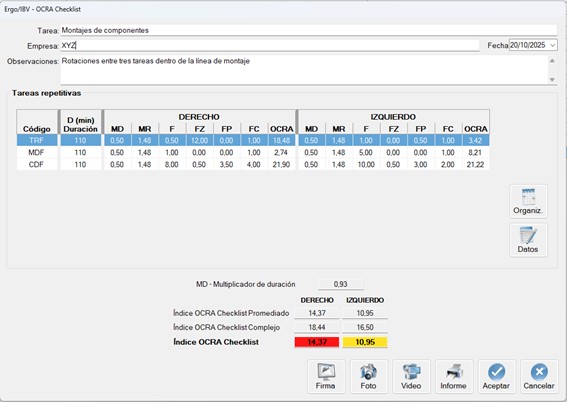
Figure 5. Results screeen
The assessment results can also be used to generate a detailed report, providing comprehensive information on the analysis, including variable identification, calculations performed, overall results and a detailed description of each task analysed.
CONCLUSIONS
The implementation of the OCRA Checklist method within Ergo/IBV represents a significant advance in the expert use of ergonomic assessment tools. It enables a recognised occupational risk prevention methodology to be transferred into an advanced digital environment that not only maintains scientific accuracy but also expands its practical applications.
Thanks to this integration, occupational health and safety professionals and workplace health managers have access to a robust and user-friendly resource for identifying risks, quantifying them and communicating results clearly and effectively.
BIBLIOGRAPHY
- Colombini, D., Occhipinti, E., Álvarez-Casado, E., Hernández-Soto, A., & Tello, S. (2012). El método OCRA checklist: gestión y evaluación de riesgos por movimientos repetitivos de extremidades superiores. Barcelona: Factors Humans.
- Colombini, D., & Occhipinti, E. (2016). Risk analysis and management of repetitive actions: a guide for applying the OCRA system (occupational repetitive actions). CRC Press.
AUTHOR’S AFFILIATIONS
Instituto de Biomecánica de Valencia
Universitat Politècnica de València
Edificio 9C. Camino de Vera s/n
(46022) Valencia. Spain
HOW TO CITE THIS ARTICLE
Author/s: Alberto Ferreras Remesal, Sonia Serna Arnau, Carlos Chirivella Moreno, Ángela Gajate Hernández, Alicia Piedrabuena Cuesta. (25 of May ofe 2026). “Implementing the OCRA Checklist Method in Ergo/IBV: A tool for the assessment of ergonomic risks associated with repetitive tasks”. Revista de Biomecánica nº 73. https://www.ibv.org/en/latest-news/implementing-the-ocra-checklist-method-in-ergo-ibv-a-tool-for-the-assessment-of-ergonomic-risks-associated-with-repetitive-tasks/
The publication of this article is funded under the “IBV 2026 Plan for Non-Economic Activities” (IMAMCA/2026), financed by the earmarked budget allocated to technology centres in the Valencian Community, as approved by the Valencian Regional Government’s Budget Act for 2026.