



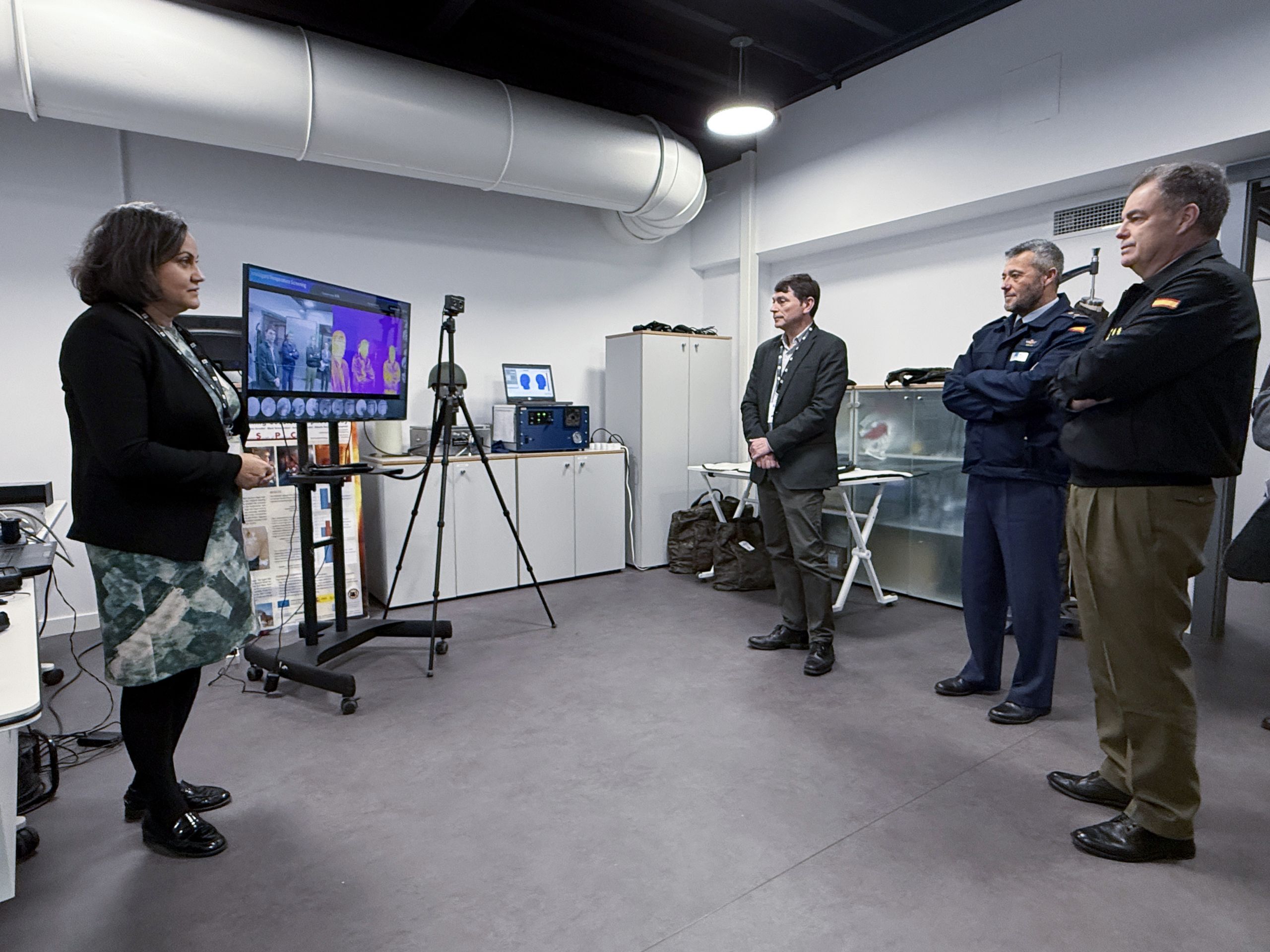
The IBV showcases its Security and Defence technological capabilities to the Defence Delegate in the Valencian Community
On Wednesday, 12 January 2026, the Defence Delegate in the Valencian Community, Ángel Adán García, visited Instituto de Biomecánica (IBV), accompanied by Ángel García Solaz, Head of Institutional Relations and Public Communication at the General Secretariat of the Defence Delegation in the Valencian Community.
Hosted by Javier Sánchez, Managing Director of IBV, and José Solaz, Market Innovation Director and coordinator of IBV’s activities in the Security and Defence field, they were able to learn about the centre’s technological capabilities in this area. The Delegate was introduced to the research and technologies developed by the centre in areas such as:
– Ergonomics, comfort and performance of combatant equipment, clothing and footwear.
– The ergonomic conditions of soldiers’ activities.
– Vehicle ergonomics and the usability of human–machine interactions.
– Improving the functionality of medical devices, and the digitalisation and humanisation of healthcare delivery.
During the visit, IBV’s participation since 2020 in the European Defence Agency (EDA) Capability Technology area (CapTech) ‘12. CBRN and Human Factors’ was highlighted, specifically within the CapTech’s “human factors” strand. IBV’s work to update the Human Factors Strategic Research and Innovation Agenda (SRIA) during 2026 was also recognised.
In addition, standout research was presented, including TERMOCONF, “New technologies to improve comfort and reduce the combatant’s thermal stress under conditions of high temperature and humidity”, developed with the companies FECSA, Fabrica Española de Confecciones, and E.CIMA, funded by the Ministry of Defence and coordinated with the DGAM and SDG PLATIN, within the COINCIDENTE 2020 programme (DN8644). Current CERVERA projects on dual-use technologies being developed by the centre were also outlined:
TACTIX, which aims to research technologies to create immersive simulation scenarios for tactical operations (security and defence), incorporating multisensory interaction (including haptics) for training and decision-support.
GUARDIANES, focused on consolidating a network of excellence to serve as Spain’s benchmark in R&D&I and the transfer of AI to security and defence, pooling capabilities and infrastructure and progressing in a coordinated manner in data, computing, algorithms/simulation and AI governance, with validation through use cases and transfer to industry and society.
COMANDO, which seeks to strengthen national technological sovereignty in defence and security through a Network of Excellence in multimodal autonomous systems (UAV, UGV, USV), moving towards validation in demanding environments (TRL ≥ 6) and the integration of centralised, distributed and onboard autonomy.
Finally, several of the centre’s most advanced facilities were visited, such as the Thermal Response Laboratory, the Human Autonomous Vehicle and the Human Movement Lab. Demonstrations showcased IBV’s capabilities and technologies in analysing the human body’s thermal response, autonomous mobility, non-invasive monitoring of physiological signals in emergency situations, scanning the human body in motion, and monitoring and analysing individuals using markerless technologies developed by IBV.