



BERTHA Project Presents Final Results to Advance Human-Centred Automated Mobility in Europe
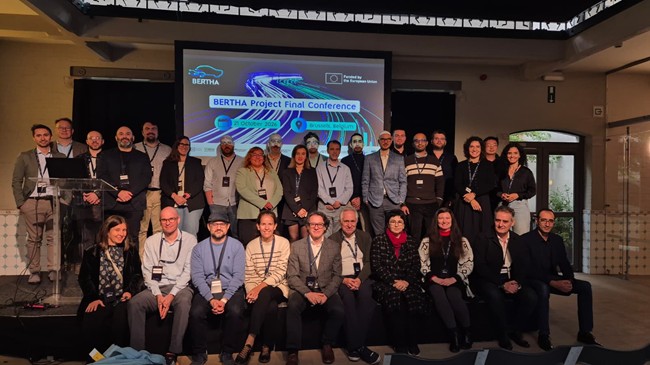
Following three years of collaborative research and innovation, the BERTHA (BEhavioural ReplicaTion of Human Drivers for CCAM) project presented its final results during its closing event, held on 21 October in Brussels. The event brought together researchers, automotive industry representatives, policymakers and stakeholders from across the Connected, Cooperative and Automated Mobility (CCAM) ecosystem to discuss how human-centred approaches can support the future deployment of automated driving technologies.
Funded under the Horizon Europe programme, BERTHA was established to address one of the key challenges facing automated mobility: understanding and replicating human driving behaviour to support the development of safer, more predictable and widely accepted automated vehicles.
Throughout the project, the consortium developed an innovative suite of methodologies, models and tools capable of reproducing different aspects of human behaviour behind the wheel, including perception, attention, cognition, decision-making and emotional responses. These developments support the design and validation of advanced driver assistance systems (ADAS) and automated driving functions that better reflect real-world driving behaviour.
Among the project’s key achievements are:
- The identification and characterisation of different driver reaction patterns and behavioural profiles;
- The development of advanced perception, cognition and decision-making models;
- The creation of tools for complex driving scenario generation and virtual simulation;
- The development of an Open Human Behaviour Data HUB for storing, sharing and analysing behavioural data;
- The validation of methodologies supporting the development and assessment of CCAM technologies and automated driving systems;
- The integration of these components into a comprehensive technological ecosystem for human-centred automated mobility.
The final event also featured a series of live demonstrations showcasing technologies developed throughout the project. Attendees explored scenario generation tools, simulation platforms, behavioural models, data analysis systems and applications supporting the validation of automated driving functions.
One demonstration highlighted how different driver profiles can be incorporated into simulation environments to assess the behaviour of automated systems under complex traffic situations. Such approaches can help accelerate the development of more robust, reliable and user-centred mobility solutions.
The event included expert discussions on the future of automated mobility, including the factors required to strengthen public trust in automated driving systems and facilitate their adoption across Europe.
As the project reaches its conclusion, BERTHA leaves behind a valuable legacy of scientific knowledge, technological tools and validated methodologies that can support future European initiatives in automated mobility. The project’s outcomes are expected to contribute to the development of transport systems that are not only more intelligent and efficient, but also more aligned with human needs, behaviours and expectations.
BERTHA (BEhavioural ReplicaTion of Human drivers for CCAM) is a project funded by the European Union under the Horizon Europe programme (Grant Agreement No. 101076360), coordinated by Instituto de Biomecánica (IBV), with the participation of Institut VEDECOM, Université Gustave Eiffel, German Research Centre for Artificial Intelligence, Computer Vision Center, Capgemini Engineering, AUMOVIO, VORTEX-Colab, Fundación CIDAUT, Austrian Institute of Technology, Universitat de València, Europcar Mobility Group, FI Group and Smart Eye AB.
More information at https://berthaproject.eu/