



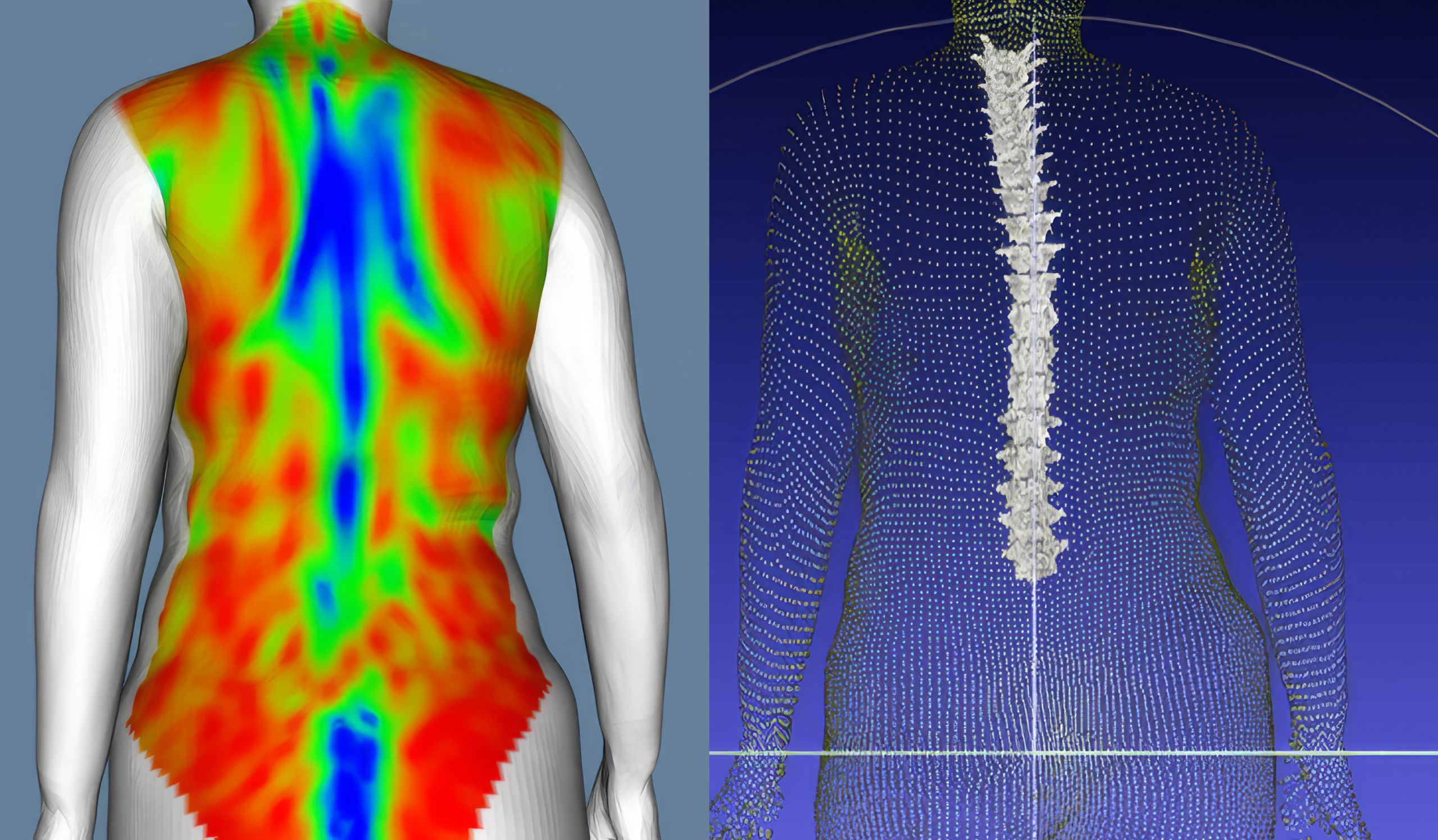
IBV uses dynamic body scanning to develop new methodologies for the study of spinal deformities
Spinal deformity is one of the conditions that can affect people’s musculoskeletal development and may lead to circulatory, respiratory and locomotor system disorders. In addition to compromising health, these pathologies can affect the confidence and day-to-day quality of life of those who suffer from them. Today, the sedentary posture typically adopted in academic or workplace settings can lead to increasingly significant abnormal spinal symptoms, which may affect the physical development of younger people and their future health. Early detection of this type of pathology is therefore key.
In clinical practice, detecting these deformities often requires the use of ionising-radiation technologies, such as X-rays or CT scans, which entails exposing patients to radiation during the diagnosis, treatment and follow-up stages.
In this context, Instituto de Biomecánica (IBV) has launched the FSPINE project, with the aim of optimising innovative biomechanical data capture solutions based on dynamic body scanning, using its MOVE4D technology. These solutions will enable the development of new methodologies for functional assessment and the study of spinal deformities, such as scoliosis, kyphosis and lordosis, facilitating the diagnosis and clinical follow-up of these pathologies by healthcare professionals. In the words of Carlos Atienza, IBV’s Director of Innovation in Health, “the project is designing clinical assessment protocols that make it possible to quantify the effects of spinal pathology on patients’ functional capacity”.
Radiation-free, contactless technology enabling comprehensive dynamic assessment
Unlike traditional methods for detecting spinal deformities, such as X-rays or CT scans, the MOVE4D dynamic body scanning technology used in FSPINE consists of a 4D capture scanner that uses infrared cameras. This makes it completely safe for the patient, as it emits no ionising radiation, avoiding the exposure risks associated with conventional systems used in clinical practice. “In addition, the system enables assessment of spinal deformation in motion, so that clinicians can see how spinal curvature changes during the patient’s gait or after performing different types of movements, throughout their progress following treatment,” states Carlos Atienza.
Personalised design of orthoses and other products
Another outcome of the research is a tool for the personalised design of orthoses and other products, improving their fit to each patient’s characteristics and enhancing the treatment of these pathologies. According to Atienza, “this project places us at the forefront of biomechanics applied to health. We are developing tools that will not only improve the study of spinal deformities, but also enable the design of treatments and products that are more tailored to the characteristics and needs of each patient. This translates into care that is safer, more efficient and more person-centred”.
A commitment to the future of health through business collaboration
In the FSPINE project, IBV has benefited from the active collaboration of the Valencian business ecosystem. The project brings together established companies with extensive track records, innovative SMEs and major firms that act as drivers, contributing their experience in research, technological development and healthcare delivery. It has therefore included collaboration with Ascires, Epidisease, Neofoam, Ortoprono and Fisiodreca’t, who have contributed their expertise in key areas such as diagnostic imaging, orthopaedic product design, and the development of solutions for rehabilitation and physiotherapy.
“The FSPINE project represents an opportunity to boost knowledge transfer to the healthcare sector, and its results are expected to have a direct impact on specialties such as orthopaedic surgery and traumatology, rehabilitation, physiotherapy and neurology,” concludes Carlos Atienza. Finally, the FSPINE project is supported by the Conselleria d’Innovació, Indústria, Comerç i Turisme de la Generalitat Valenciana, through IVACE+i, and is funded by the European Union through the ERDF Programme Comunitat Valenciana 2021–2027 (IMDEEA/2025/67).