



Integrating human behaviour into automated driving
6 October 2026.
Author’s: Andrés Soler Valero, Helios de Rosario Martínez, Juan Manuel Belda Lois, Begoña Mateo Martínez, José Solaz Sanahuja, Elisa Signes i Pérez.
Instituto de Biomecánica (IBV)
The transition towards Connected, Collaborative and Automated Mobility (CCAM) requires more than just technological innovation: it demands a deep understanding of how humans perceive, make decisions and act in complex traffic environments. The European BERTHA project, led by the Instituto de Biomecánica (IBV), tackles this challenge by integrating advanced behavioural models, artificial intelligence and large-scale data analysis to improve the safety, realism and acceptance of automated driving systems.
INTRODUCTION
As part of the BERTHA project, the IBV plays a key role in the development of the Driver Behaviour Model (DBM), a core technological component designed to replicate human driving behaviour in a structured, scalable and scientifically grounded manner.
The following article outlines the work carried out to date by the IBV on the project.
DEvelopment
A MODULAR AND SCALABLE MODEL OF THE HUMAN DRIVER
The Driver Behaviour Model (DBM) developed at BERTHA is designed as an integrated representation of how humans perceive, make decisions and act whilst driving. Rather than modelling driving as a purely mechanical task, the DBM incorporates multiple processes that interact with one another:
- Perception of the traffic environment
- Risk assessment and decision-making mechanisms
- Affective influences on behaviour
- Motor execution and vehicle control
IBV is leading the development of two critical modules within this congitive architecture: the Affective Module and the Motor Control Module.
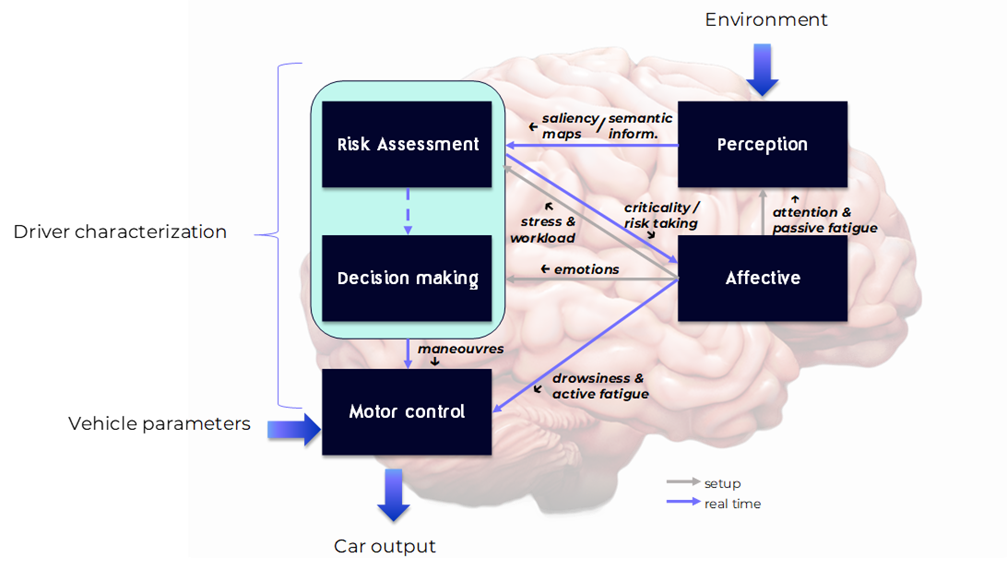
The Affective Module captures how emotional states — such as stress or workload — can alter driving responses. The Motor Control Module models the operational layer of behaviour: how steering, acceleration and braking are executed in response to decisions and environmental inputs.
The architecture has been designed to be modular and scalable, distinguishing between deterministic components (for example, the perception and risk assessment modules) and stochastic components associated with behavioural variability (for example, affective and motor processes).
This separation facilitates progressive development and integration, whilst maintaining interpretability.
INTRODUCTION OF PROBABILISTIC INTELLIGENCE INTO MOTOR CONTROL
One of the IBV’s most significant contributions has been the evolution of the Motor Control Module towards a probabilistic framework. Human motor behaviour is not deterministic; it exhibits intra- and inter-individual variability that must be captured to ensure realistic simulation results.
To address this, the variables modelled by the DBM have been adapted to support integration within a Bayesian architecture.
This probabilistic formulation enables the model to represent uncertainty, variability between driver profiles and contextual adaptation — key aspects when evaluating automated systems in complex, mixed-traffic environments.
From human data to behavioural intelligence
FROM HUMAN DATA TO BEHAVIOURAL INTELLIGENCE
The scientific rigour of the DBM is grounded in empirical evidence. IBV has conducted controlled experiments on its Human Autonomous Vehicle (HAV) dynamic driving simulator to calibrate and validate motor control parameters based on human performance.
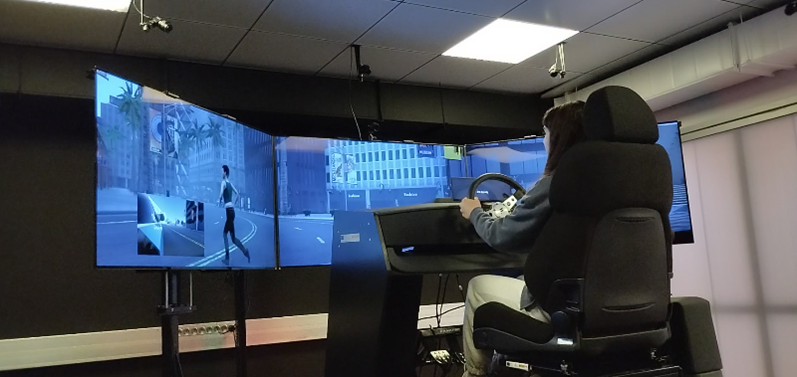
These studies investigate how vehicle control dynamics depend on:
- Age and gender
- Driving experience
- Driving style
- Risk perception
- Emotional states and their influence on vehicle dynamics
In parallel, the IBV has collaborated with consortium partners in analysing data from Operational Field Trials in order to identify the relevant variables for validation.
These efforts have contributed to the establishment of a harmonised dataset from multiple sources, capable of serving as a basis for modelling human drivers and evaluating CCAM systems under realistic operating conditions. It is important to note that the DBM does not simulate an ‘ideal’ driver. Instead, it incorporates variability, errors and potentially risky behaviours depending on the driver type and the demands of the context. This feature is essential for evaluating automated systems under realistic assumptions of human behaviour.
INTEGRATION OF BEHAVIOURAL INTELLIGENCE INTO SIMULATION ECOSYSTEMS
Beyond the development of models, the IBV has contributed to the operational integration of behavioural intelligence into advanced simulation platforms.
Collaboration with the project’s technology partners has enabled the definition of strategies to link the outcomes of tactical decision-making with operational motor control. This includes the definition and tracking of waypoints, the transfer of tactical outcomes to vehicle control, and the dynamic adaptation of behaviour driven by affective states.
The IBV has also provided structured software packages for the Motor Control Module to facilitate integration within the collaborative research platform developed at BERTHA, known as the Human Behaviour Data HUB, addressing aspects of interoperability and governance.
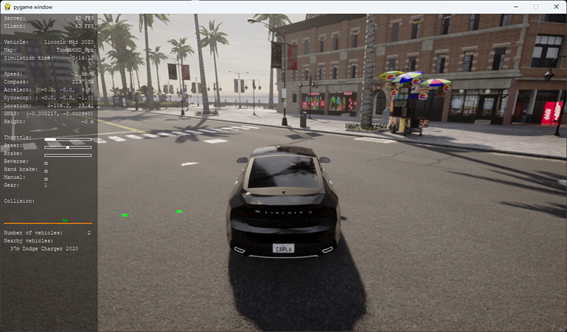
These developments enable the training and evaluation of AI-based autonomous driving models in environments using the open-source CARLA simulation software, under more realistic behavioural simulations, thereby supporting the development of more naturalistic driver assistance systems.
CONCLUSIONS
TOWARDS SAFER AND MORE RELIABLE CCAM SYSTEMS
By integrating human behavioural intelligence into simulation and validation processes, BERTHA accelerates the development of safer and more comprehensible automated mobility solutions. The use of modular architectures, standard interfaces and harmonised data solutions facilitates integration and adoption by academic and industrial stakeholders.
The IBV’s contribution ensures that autonomous systems are assessed not only on the basis of technical performance parameters, but also in relation to realistic human behaviour patterns, which represents a crucial step towards increasing user confidence and social acceptance of CCAM technologies.
Through BERTHA, the IBV continues to strengthen its leadership in biomechanics, human behaviour modelling and safety-oriented technological innovation, contributing to a future of smart, reliable and deeply people-centred mobility.
This research activity is carried out as part of the BERTHA project (GA101076360). A project funded by the European Union. However, the opinions and views expressed are solely those of the authors and do not necessarily reflect those of the European Union or the European Climate, Infrastructure and Environment Executive Agency (CINEA). Neither the European Union nor the authority responsible for awarding the grant accepts responsibility for them.

AUTHOR’S AFFILIATIONS
Instituto de Biomecánica de Valencia
Universitat Politècnica de València
Edificio 9C. Camino de Vera s/n
(46022) Valencia. Spain
HÓMO CITAR ESTE ARTÍCULO
Author/s: Andrés Soler Valero, Helios de Rosario Martínez, Juan Manuel Belda Lois, Begoña Mateo Martínez, José Solaz Sanahuja, Elisa Signes i Pérez. (6 of October of 2026). “Integrating human behaviour into automated driving”. Revista de Biomecánica nº 73. https://www.ibv.org/actualidad/implementacion-del-metodo-ocra-checklist-en-ergo-ibv-una-herramienta-para-la-evaluacion-de-riesgos-ergonomicos-por-tareas-repetitivas/

The publication of this article is funded under the “IBV 2026 Plan for Non-Economic Activities” (IMAMCA/2026), financed by the earmarked budget allocated to technology centres in the Valencian Community, as approved by the Valencian Regional Government’s Budget Act for 2026.