



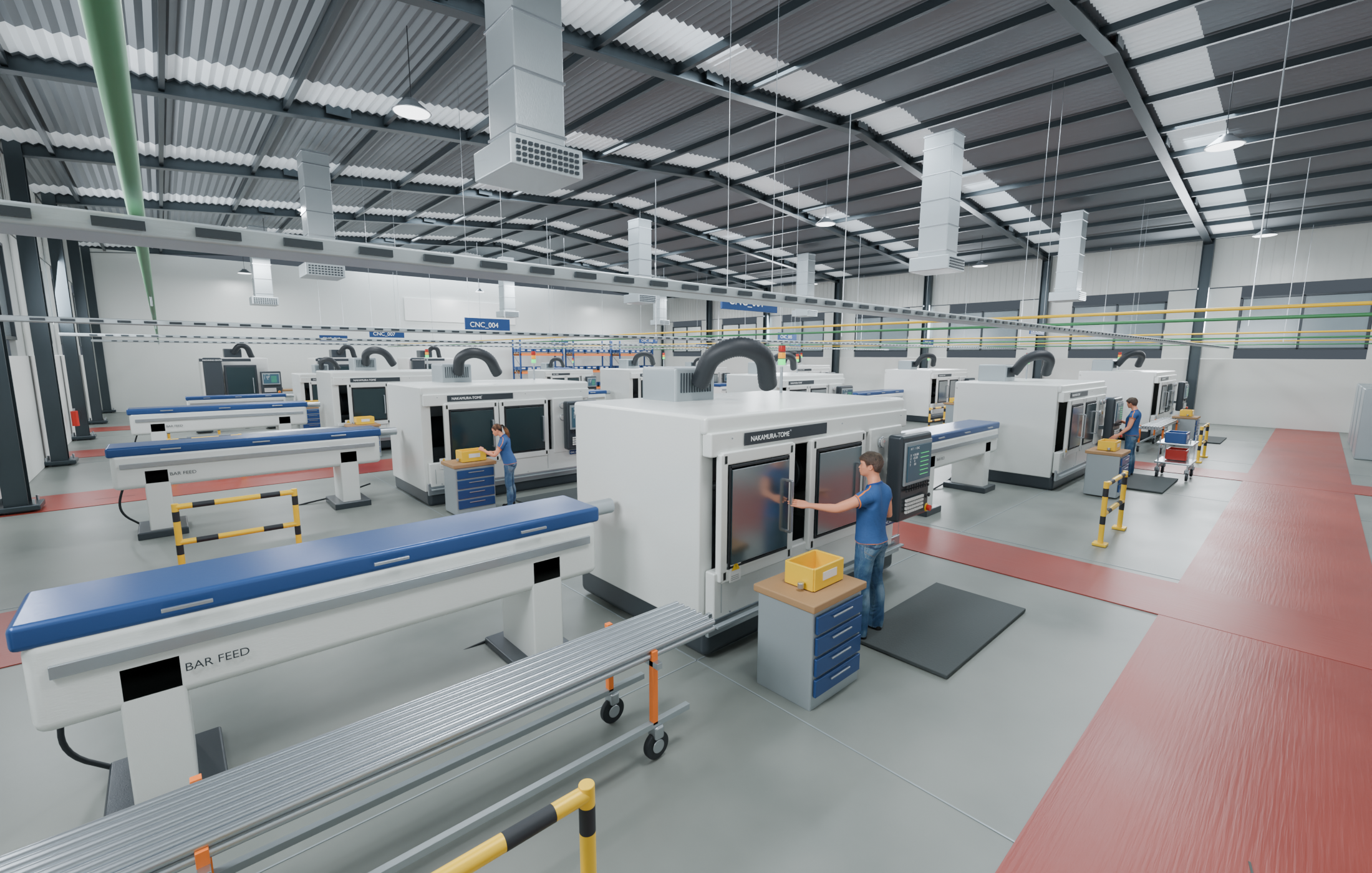
A Valencian project takes a step towards the workplace of the future with people-centred virtual worlds
Digital transformation is revolutionising the way companies design and manage their production processes. However, many of these technologies have traditionally been developed with a focus on processes and equipment, with less attention paid to adapting them to workers’ capabilities. With the aim of moving towards a more human-centred and intelligent model, the technology centres ITI, Instituto de Biomecánica (IBV), Inescop, ITC and AIMPLAS have launched the EMPATIA project, an R&D initiative that will develop advanced virtual environments capable of adapting to workers’ physical and cognitive capabilities.
The research will enable the creation of workstations based on virtual worlds, digital twins, artificial intelligence and immersive technologies, making it possible to validate the user experience before implementation. This will facilitate decision-making in workstation design and contribute to improving well-being in the workplace.
EMPATIA proposes a paradigm shift in the interaction between people and technology. Unlike traditional models, in which workers must adapt to their workstations, the project will develop tools capable of personalising information, assistance and the working environment according to the characteristics and needs of each individual user.
To achieve this, the research centres will combine virtual reality and mixed reality technologies with artificial intelligence, advanced sensor technologies and digital models representing people, production processes and environments. These capabilities will make it possible to create virtual spaces that can interpret information relating to workers’ physical and cognitive states, dynamically adapting the way instructions, alerts and recommendations are presented while tasks are being performed.
Virtual worlds to improve well-being, safety and productivity
One of the project’s main objectives is to develop methodologies and tools that enable the simultaneous analysis of interactions between workers, machinery and the working environment. This information will be integrated into advanced virtual worlds and digital twins, facilitating the simulation of work scenarios, the assessment of the impact of process or technological changes on safety, the ergonomic assessment of processes, the early detection of risks and the optimisation of operations before their implementation in real-world environments.
The project will also investigate new adaptive Mixed Reality interfaces capable of providing workers with contextual information directly within their working environment. These interfaces will be able to dynamically adapt the information displayed according to the task, environmental conditions and the worker’s physiological and cognitive state, providing more intuitive and personalised guidance.
This will enable companies to validate new workstation configurations, production processes and digital assistance systems while reducing the time, costs and risks associated with physical testing. Furthermore, the technologies developed will help minimise ergonomic risks, fatigue and cognitive overload, promoting more inclusive and safer working environments adapted to each individual’s capabilities.
Research with cross-sector impact
EMPATIA is being developed in close collaboration with ten companies from the Valencian Region. INNOAREA, TARGET3D, VIRTUARCHSTUDIO and IDEA will contribute their expertise in immersive technologies, digitalisation and virtual worlds. Meanwhile, FACTOR, ARCIBLANSA, Cerámica Nulense, Hormas ZEN, Vicedo Martí and Faperin will participate in validating the developments in real industrial environments across the advanced manufacturing, ceramics, footwear and plastics sectors. This collaboration will ensure that the technologies developed can be adapted to the needs of different production contexts and validated under real operating conditions.
Although the use cases will focus on strategic sectors for the Valencian Region, the solutions developed will have the potential to be applied across numerous industrial and service sectors, where digitalisation processes are creating an increasing demand for advanced tools to improve interaction between people and technology. The initiative will also contribute to developing technological capabilities in areas of strategic importance to Europe, such as artificial intelligence, virtual worlds, advanced simulation, digital twins and immersive technologies, strengthening industrial competitiveness and European technological autonomy.
The EMPATIA project is being carried out within the framework of the call for grants aimed at technology centres in the Valencian Region for the development of non-economic R&D projects in the technological areas defined by the Strategic Technologies for Europe Platform (STEP). The initiative is supported by IVACE+i and funded by the European Union through the European Regional Development Fund (ERDF), with the aim of promoting the development of strategic technologies and strengthening the competitiveness, innovation and technological autonomy of European industry.