



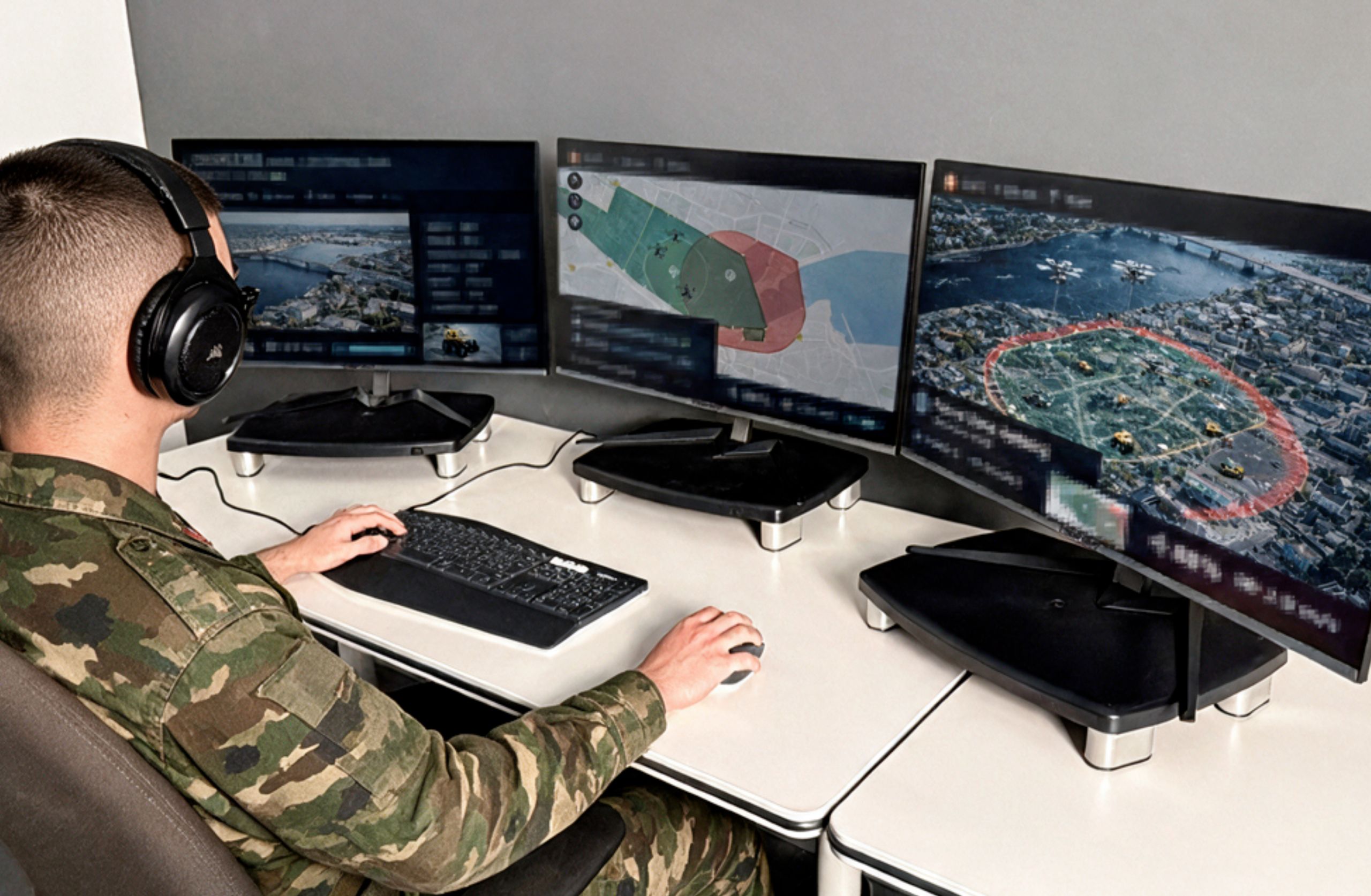
The IBV revolutionizes security and defense environment simulation with the “digital human.”
Against an international backdrop marked by conflicts between countries, the growing proliferation of hybrid threats, rising violence in various regions of the world and profound changes in the global geopolitical landscape, Europe has been compelled to take on a more active and autonomous role in defence and security, requiring the development of new technological capabilities.
This context has led to the creation of TACTIX, the ‘Cervera Network for Research into Advanced Technologies for Cognition, Tactical Simulation and Adaptive Training in Critical Scenarios through eXtended Interfaces’. The Network comprises IBV; the Centro Tecnológico Industrial de Castilla-La Mancha (ITECAM), which coordinates the Network; the Centro Tecnológico de Automoción de Galicia (CTAG); the Asociación de Investigación de la Industria Textil y Cosmética (AITEX); the Centro Tecnológico de la Información y Comunicación (CTIC); the Instituto Tecnológico de Informática (ITI); and Lortek, S.Coop. (LORTEK).
TACTIX was created with the aim of advancing the development of technologies used in advanced immersive simulations for the training of security and defence personnel, as well as decision-support systems. These technologies have evolved considerably in recent years, enabling the development of increasingly sophisticated simulators that can also be applied to the training of professionals responsible for emergency management. This is an increasingly important field given the rise in extreme events and natural disasters associated with climate change, in which the Armed Forces play a fundamental role in emergency response.
Despite these advances, current technologies still have limitations when it comes to reproducing the conditions that may arise in critical situations in a fully immersive and realistic manner. TACTIX aims to overcome these barriers by incorporating the sense of touch, alongside sight and hearing, through advanced haptic interfaces based on sensors and actuators. This will make it possible to create more realistic training scenarios using extended reality techniques, improving professionals’ operational preparedness while reducing training-related risks. Assessing an individual’s cognitive state will also make it possible to adapt both the scenario and the training to their needs, accelerating the learning process and improving their ability to respond appropriately in critical and stressful situations.
The initiative, with a budget of almost €6 million and a duration of three years, is funded by the Centre for Technological Development and Innovation (CDTI) through the Ministry of Science, Innovation and Universities.
The ‘Digital Human’ at the heart of simulation
The concept of the digital human is becoming increasingly important in immersive simulation environments. A digital human is a virtual representation of a person designed to reproduce aspects such as their appearance, movements and behaviour realistically. These models make it possible to transfer human characteristics and responses into the virtual environment and provide the basis for developing predictive models capable of anticipating how an individual may respond to different situations or conditions. The greater the realism and accuracy of the digital human, the greater the simulation’s ability to reproduce scenarios that closely resemble real-life situations and to provide useful information for training and decision-making.
Within the TACTIX project, IBV will contribute its international leadership in anthropometry, human factors and biomechanics to drive the development of highly realistic digital humans capable of representing the diversity and characteristics of military personnel. These digital humans will provide virtual environments with the level of realism they require. In a parallel line of work, IBV will contribute to the development of predictive models of human behaviour in different operational scenarios, enabling training situations to be personalised according to the needs and capabilities of each professional.
To achieve this, IBV will apply a human-centred approach, adapting technologies and methodologies that enable the comprehensive assessment of combatants’ physical, cognitive and psychological state during simulated operations.
IBV will also specifically coordinate the creation of structured data repositories for military populations. These databases will integrate anthropometric, physiological, emotional and cognitive variables that will be used to feed and enhance both the digital humans and the associated predictive models.
According to José Solaz, Market Innovation Director coordinating IBV’s activities in the field of Security and Defence, ‘The generation of AI-based predictive models trained using data specific to the military context will enable highly realistic simulations and preventive assessments of users’ performance and resilience. Furthermore, this research will make it possible to design tactical systems and personal protective equipment that are perfectly adapted to the combatant of the future.’
Dual-use technologies with applications in civilian sectors
Although TACTIX is primarily focused on military operational environments, its results clearly have dual-use technology potential. Innovations in immersive simulation, generative artificial intelligence and biometric monitoring may therefore be transferred to civilian applications in the short and medium term, with potential uses in sectors such as healthcare, industry and advanced education. One example would be the use of sensors to assess an individual’s cognitive state in workplace environments, enabling corrective measures to be applied automatically in stressful or high-risk situations.
Through this initiative, IBV is making its extensive experience in applied research and technology transfer available to the Network, positioning itself as one of the key centres contributing to the modernisation of infrastructure and applications related to security and defence in Spain and Europe.
Finally, the TACTIX project (CER-20251027) is funded by the CDTI (Centre for Technological Development and Innovation, E.P.E.), through the Ministry of Science, Innovation and Universities, under the grant programme for ‘Cervera’ Centres of Technological Excellence, within the framework of the State Plan for Scientific and Technical Research and Innovation 2024–2027.