



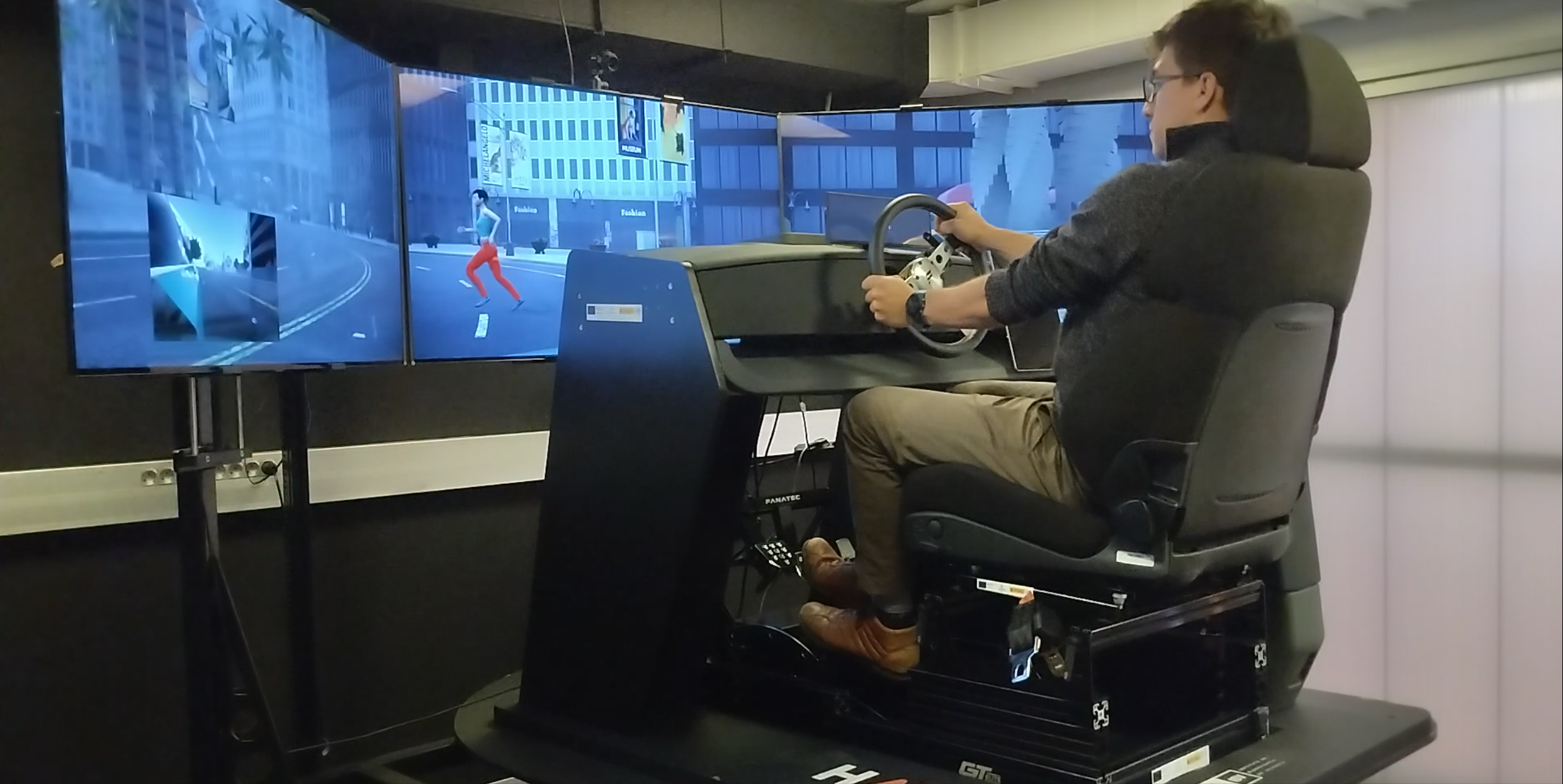
IBV coordinates a European project that will help autonomous vehicles behave in a more human-like and safer way
Mobility is undergoing a profound transformation and moving towards what is known as Cooperative, Connected and Automated Mobility (CCAM). Instituto de Biomecánica (IBV) aims to address this challenge through the European BERTHA project, which it coordinates and which brings together 14 partners from 6 countries. The initiative was launched with the aim of developing a Driver Behaviour Model (DBM) to help autonomous vehicles behave in a safer, more human-like and predictable way, which is crucial to achieving social acceptance.
In a CCAM ecosystem, autonomous vehicles do not operate in isolation. They form part of a social environment, sharing the road with pedestrians, cyclists and other drivers.
A vehicle may behave correctly from a technical point of view: it may comply with traffic rules, brake at the appropriate time and remain within its lane. However, if people perceive its behaviour as unusual, too abrupt, excessively cautious, aggressive or difficult to interpret, they will not trust it.
On the road, many interactions are not based solely on written rules; they also depend on implicit communication, shared expectations and behavioural patterns that people understand naturally.
Predictability is therefore essential. If people can understand and anticipate the actions of an autonomous vehicle, they are more likely to trust it and accept it as part of everyday mobility.
Real-Time Perception, Affective Intelligence and Human-Like Motor Control
To address this need, the project has developed a Driver Behaviour Model (DBM) comprising 4 modules: perception, cognition, affective-emotional and motor control, which have been validated using data from simulation and real-world testing.
Perception Module
Drawing on hours of real-world driving data collected from dozens of diverse users, the Perception Module provides real-time 360° attention mapping within the CARLA simulation environment. This module uses advanced machine learning techniques to replicate human gaze and attention distribution, enabling automated vehicles to interpret and anticipate driver attention in complex and dynamic traffic scenarios. The result is a system that not only reacts to its environment, but does so in a way that reflects human situational awareness, enhancing both safety and trust.
Cognition Module
In BERTHA, cognition is modelled through two submodules for Risk Assessment and Decision-Making, which simulate the driver’s perception and understanding of the traffic situation and determine the most appropriate driving behaviour according to the level of perceived and accepted risk, with the aim of progressing safely through the environment. These two cognitive processes have been modelled and simulated on the basis of the theoretical COSMODRIVE model and specifically adapted to the objectives and use cases investigated within the project.
Affective Module
The Affective Module is built on Bayesian Networks, enabling it to predict and model key mental states such as fatigue, drowsiness and stress. By integrating physiological and demographic data, this module provides a nuanced understanding of driver readiness and emotional state. This capability is crucial for developing automated systems that can adapt to the variability of human behaviour, ensuring that vehicles respond appropriately in both routine and critical situations.
Motor Control Module
Calibrated using data from a substantial number of participants, the Motor Control Module generates probability distributions for a wide range of driver actions. This probabilistic approach captures the inherent variability in human driving styles, from cautious, aggressive and confident to assertive, and translates it into nuanced, context-aware vehicle responses. By narrowing the gap between simulation and real-world driving, this module enables the development of automated vehicles that behave in ways that are predictable and acceptable to human users.
According to Helios De Rosario-Martínez, researcher at Instituto de Biomecánica (IBV), “the release of these four software components has been the starting point for the implementation of BERTHA’s DBM as a modular and scalable resource that will facilitate CCAM research in the field of human driver behaviour”.
BERTHA’s results represent an important step towards integrating human behaviour into future automated mobility systems.
Validation and Real-World Impact
A fundamental pillar of BERTHA’s methodology is the rigorous validation of its modules using data from Field Operational Tests, commonly known in the automotive sector as FOTs. By grounding performance assessment in real driving conditions, the project ensures that the modules developed are robust and reliable enough to continue evolving towards integration into next-generation automated mobility systems. This real-world validation is essential to building both public and regulatory confidence in automated vehicles and paving the way for broader social acceptance.
Strategic Importance for Cooperative, Connected and Automated Mobility
The release and validation of these advanced driver behaviour modules positions BERTHA at the forefront of the global effort to develop trustworthy, human-like automated mobility. By addressing the critical gap in modelling the holistic, personal and cultural aspects of human driving, BERTHA’s research contributes directly to the European Union’s vision for safe, inclusive and efficient mobility. The project’s scalable and probabilistic approach also establishes a new benchmark for digital validation and interoperability across the CCAM industry.
In the words of Andrés Soler Valero, BERTHA project coordinator and researcher at IBV, “the release of the DBM modules marks a turning point for research and development in the automotive sector. By moving away from rigid ‘black-box’ systems towards a modular driver behaviour model, we are enabling manufacturers and developers to iterate more quickly and accurately. These functional building blocks can be integrated into existing workflows, reducing the cost and complexity involved in developing next-generation Advanced Driver Assistance Systems (ADAS) and personalised in-vehicle experiences”.
About BERTHA:
BERTHA (BEhavioural ReplicaTion of Human drivers for CCAM) is a project funded by the European Union under the Horizon Europe programme (Grant Agreement No. 101076360), coordinated by Instituto de Biomecánica (IBV), with the participation of Institut VEDECOM, Université Gustave Eiffel, German Research Centre for Artificial Intelligence, Computer Vision Center, Capgemini Engineering, AUMOVIO, VORTEX-Colab, Fundación CIDAUT, Austrian Institute of Technology, Universitat de València, Europcar Mobility Group, FI Group and Smart Eye AB.
More information at https://berthaproject.eu/